 Relax
RelaxEFT Tapping
An interactive guide to the 9-point tapping sequence — for anxiety, stress, and acute overwhelm.
EFT, also known as emotional freedom therapy, is a brief self-administered ritual that combines gentle tapping on 9 acupressure points with a short spoken statement. This page walks you through one round at a steady pace. Settings are optional; the defaults work for most people.
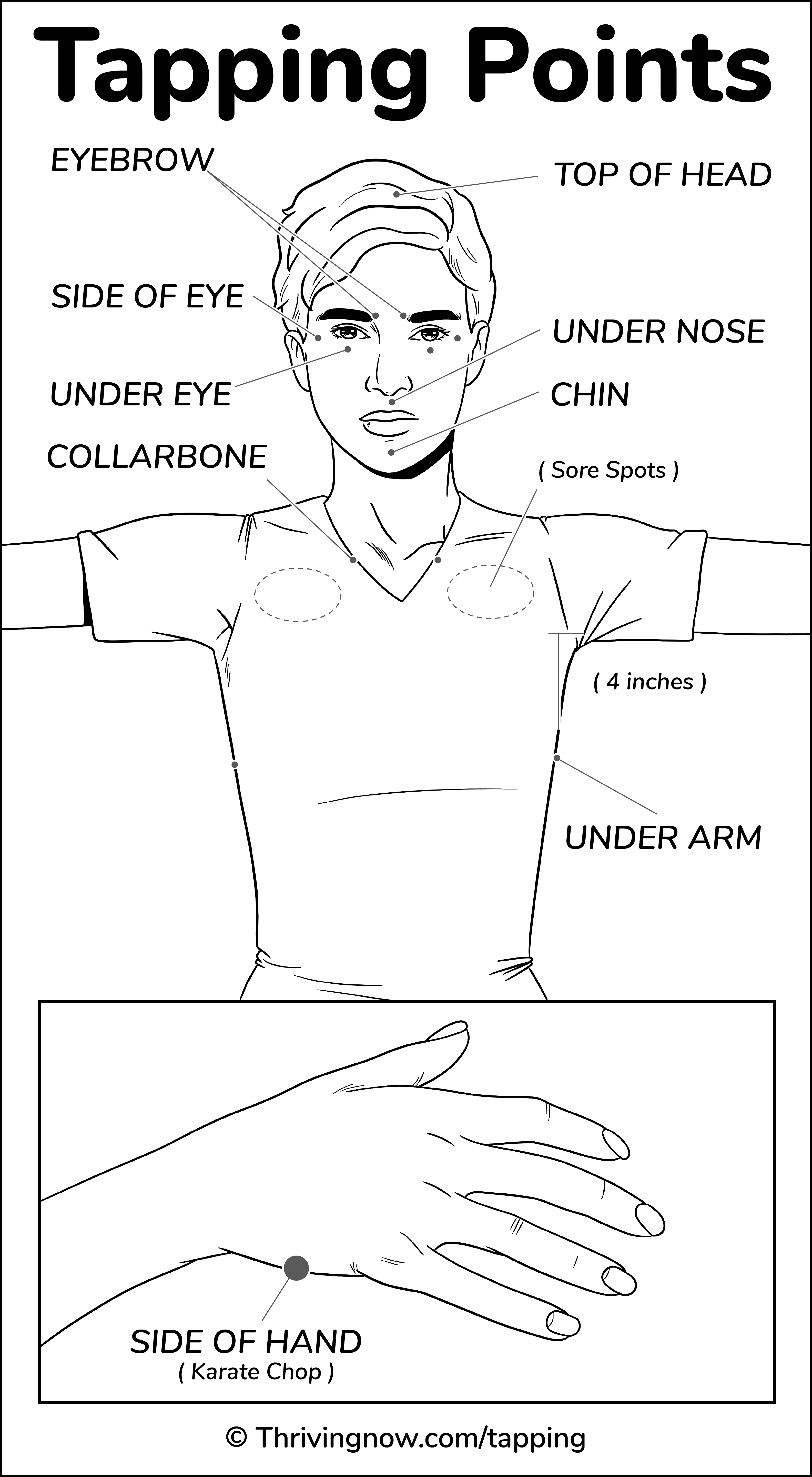
Diagram source: Thriving Now
How EFT tapping works
EFT — also called the emotional freedom technique, emotional freedom tapping, tapping therapy, or simply the tapping technique — combines four ingredients into one short ritual:
- Brief exposure to a distressing thought or feeling, by saying it aloud during the setup
- A self-acceptance phrase ("…and I deeply and completely accept myself")
- Gentle physical stimulation via tapping on 9 acupressure points
- Slow, controlled breathing as you cycle through the points at about one tap per second
Each of these has independent evidence behind it. Brief exposure with a calm bodily focus is the active mechanism in many anxiety treatments. Self-acceptance phrases reduce the shame loop that intensifies distress. Slow breathing activates the vagus nerve. Repetitive light touch is grounding. EFT bundles them into a portable, self-administered protocol. You'll also see it written as the tapping emotional freedom technique, eft emotional freedom tapping, or simply EFT and tapping — all the same method. It's sometimes called meridian tapping too, after the acupuncture meridians its creators referenced; that proposed mechanism has no scientific support, but the components above do.
The 9 tapping points
- Karate Chop (KC) — fleshy outer side of either hand, below the little finger. Used for the setup statement.
- Eyebrow (EB) — the inner edge of the eyebrow, just above and to the side of the nose.
- Side of Eye (SE) — on the bone at the outer corner of the eye.
- Under Eye (UE) — on the bone directly below the pupil, about a centimeter under the eye.
- Under Nose (UN) — between the nose and the upper lip.
- Chin Point (CH) — between the lower lip and the chin, in the small crease.
- Collarbone (CB) — about 2 cm below the collarbone, just to the side of the sternum.
- Under Arm (UA) — about 4 inches below the armpit, on the side of the body.
- Top of Head (TH) — the crown of the head, where you'd find the soft spot on a baby.
Tap each point gently with two fingers, about 5–7 times, before moving to the next. These nine EFT points are the same in every version of the protocol. The pressure is light — the goal is rhythmic contact, not stimulation of "energy points."
EFT tapping for anxiety
Tapping for anxiety is the most-studied use of EFT. Anxiety symptoms — racing thoughts, chest tightness, shortness of breath, looped worry — usually drop in intensity within one or two rounds. The combination of slow breathing, exposure to the worry, and self-compassion phrasing interrupts the anxiety spiral that holds the symptoms in place.
For ongoing anxiety, a daily 5-minute tapping practice tends to outperform sporadic crisis-mode tapping. Most clinical EFT studies show effects after 4–8 sessions of regular practice rather than from a single session.
A close cousin of EFT for anxiety is the butterfly hug — alternating shoulder taps with no setup phrase. It uses the same active ingredients (slow breathing, rhythmic light touch, dual attention) without the cognitive load of remembering nine points, which makes it a useful alternative when you're too activated to recall a sequence.
EFT tapping for stress
Tapping for stress is essentially the same protocol applied to whatever specific stressor is on your mind: a difficult conversation ahead, an overdue task, a recurring work pressure. Tap on the most concrete version of the stressor you can name — "this presentation tomorrow" rather than "stress in general."
EFT for stress works fastest when paired with sleep, exercise, and breaks; treat it as a tool to interrupt acute stress, not a replacement for the structural changes that lower baseline stress.
EFT tapping for sleep
EFT for sleep — sometimes called tapping for sleep or tapping meditation before bed — uses the same protocol with sleep-specific phrases ("this restless feeling," "this 3 a.m. mind"). The slow breathing built into the sequence is what does most of the work; the points serve as a physical anchor that keeps your attention from wandering back to the racing thoughts.
If you wake at night and can't fall back asleep, two rounds of tapping in bed are often enough to shift you into drowsiness. Pair it with 4-7-8 breathing for a deeper sleep-oriented practice.
What science says
EFT is genuinely contested in the scientific literature. Honest answers acknowledge both sides.
- Sebastian & Nelms (2017) — meta-analysis of 7 randomized controlled trials of EFT for PTSD, finding a large effect size (PubMed).
- Clond (2016) — meta-analysis of 14 RCTs of EFT for anxiety, reporting significant reductions vs. controls (PubMed).
- Seok & Kim (2024) — meta-analysis of 18 RCTs of EFT for depressive symptoms, reporting a large overall effect size (PubMed).
- Boness, Pfund & Tolin (2024) — argues that the "meridian" mechanism behind EFT is not scientifically supported and that any effects are likely due to exposure and breathing components rather than tapping itself (PubMed).
- Pfund, Boness & Tolin (2024) — commentary on a recent EFT-for-PTSD meta-analysis, citing small samples, high researcher allegiance, and few active controls in the underlying studies (PubMed).
- Science-Based Medicine — long-running argument that EFT studies show "treatment-vs-nothing" effects rather than effects beyond placebo and standard exposure (read).
A reasonable working summary: many people experience real symptom relief from EFT, the proposed "meridian" mechanism has no scientific support, and the active ingredients are likely exposure, slow breathing, and self-compassion phrasing — all of which are valuable in their own right. Use EFT alongside, not instead of, evidence-based mental health care.
How to do EFT tapping (step by step)
Most EFT therapy techniques you'll find online follow the same core sequence — identify, rate, set up, tap, breathe, re-rate:
- Identify the issue — name what's bothering you in one specific phrase ("this anxiety about the meeting tomorrow").
- Rate the intensity 0–10 (this is the SUDS scale: subjective units of distress). Note the number.
- Setup statement — tap continuously on the karate-chop point of one hand and say (out loud or quietly): "Even though I have [your issue], I deeply and completely accept myself." Repeat 3 times.
- Tapping sequence — tap each of the 9 points 5–7 times in order, saying a short reminder phrase ("this anxiety," "this feeling") on each point.
- Take a slow breath at the end of the round.
- Re-rate intensity. If still elevated, repeat 1–3 more rounds, slightly modifying the reminder phrase if useful ("the rest of this anxiety," "still some of it").
This is not a substitute for psychotherapy. For serious symptoms, please consult a mental health professional. EFT works best when combined with other evidence-based approaches.
This page describes EFT (Emotional Freedom Techniques) as a self-help practice. RelaxQuickly is not affiliated with EFT Universe, the Energy Psychology Institute, or any other EFT-branded organization or training program.